
Newcomers to board games these days are met with such a variety of choices that it can be a little difficult to pick a starting point. But no matter their experience with gaming in the past; whether it’s just video games, or through RPGs, or from coming from card games like Magic: The Gathering, there’s one game that every fresh face is warned away from.
Mage Knight.
Working your way towards playing Mage Knight is to go on a quest of Spielbergian proportions. You’ll grab your whip and fedora, setting out across the globe with uncertain fate. You’ll climb the highest mountains of Uwe Rosenberg, ride in the biplane of Vital Lacerda, and I’m pretty sure I met more than one Nazi along the way (of course, it’s 2018 and I live in the southern United States, so…)
Finally, you reach the holy grail of Vlaada Chvatil’s Mage Knight. Then, and only then, you reach for the worn chalice that so many gamers have touched before. Your friends call out from behind you –
“You’re not ready!” they yell as they reach to pull you back from the brink.
“No! You can’t handle it! It’s too soon!” they beg, averting their eyes as they can’t bare to watch.
“You’re such a nerd.” (My wife may have made an entrance.)
If you’re ready… if your knowledge of board game conventions is established; if one of your rooms looks like an Ikea shelf showcase; if you’ve read every manual twice and watched every tutorial on YouTube; and if your table is as big and empty as your social calendar; then it’s a truly glorious experience. A world opens up before you full of richly detailed landscape. It’s a vibrant game of changing fortunes and cunning plans, where simply moving between two spaces on a turn can seem an insurmountable challenge to be conquered. Round after round a new hand of cards demands a new plan, a new tactical roadmap to solve your immediate problem in pursuit of larger strategy.
If you weren’t ready…… you melt.
The sheer volume of rules, the brain-numbing complexity of the manual, the various game modes, the tremendous downtime between player turns… all of it is antithetical to good game design. One day, I think Jeni and I are going to invite a super-casual gamer to our board game day just to record the expression on their face as we attempt a rules explanation.
And yet.
Mage Knight holds a special place in the board game community, and is still considered by many to be Vlaada Chvatil’s masterpiece.
Alright, Jeni, I get it. This isn’t a Mage Knight review. Stop smacking me with the newspaper.
Why then, am I reviewing Mage Knight for the last 400 or so words? Star Trek: Frontiers IS Mage Knight. It’s not 100% Mage Knight… perhaps closer to 99.9%. So closely related are the two games that were they to mate, they’d give birth to Cards Against Humanity. With expansions.
From the hexagon shaped tiles to the cardboard tokens to the big baddies with unnecessary clicking bases meant to show you more info at a glance, everything will feel instantly familiar. In fact, to anyone who understands how to play Mage Knight, a game of Star Trek: Frontiers will be immediately playable with only a quick glance at the manual. Vlaada Chvatil’s name still adorns the box, joined proudly by Andrew Parks. In its heart of hearts it’s only a reskin of its predecessor, but there’s something in the Star Trek formula that adds its own sort of magic to this former fantasy romp.
Maybe it’s just a matter of theme. Maybe I’m a dedicated Trekkie who falls in love a little with scooting the USS Enterprise 1701-D across the board. Maybe drawing a hand of cards to see Picard’s sexy smoulder looking back at me is enough to ignite my inner fanboy’s flames. (Jeni, I need that card back. Please.) Miraculously, it all works.
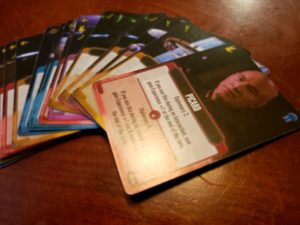
Yes, that card.
Sure, Andrew Parks streamlined a couple rules. One less color of mana (re-themed appropriately into Data Crystals). Instead of different movement rules for day and night cycles, the universe provides a comfortable constant of darkness to journey through with its unchanging rules. One clunky combat rule has been simplified as well, but outside of these relatively minor tweaks – it’s Mage Knight. And like Mage Knight, it’s a true treat when the table is set for one.
I approached Star Trek: Frontiers when I was looking for something with a bit more depth in my solo play. Not just depth – I wanted challenge. Importantly, I wanted to the possibility of failure, too. Andrew Parks gave me all of that in a beautiful presented package. As a solo adventure, this isn’t for the faint of board gaming heart. Minutes will tick away as you stare at the selection of cards in your hand, trying desperately to figure out if you can move twice and manage a successful attack in one turn… or will you have to waste time and split up your plan over multiple turns? Will your next hand of cards support that plan? You’ll think back over your starting deck and the meager selection of cards you’ve managed to add to the deck – maybe. You look at the couple crew members you’ve recruited, wondering if Geordi could push you over the edge this turn. Or maybe you could just go in a different direction and take advantage of Weiyun’s silver tongue?
In this way, the game presents you with a challenge of epic proportions worthy of its space opera license. Now, one hour into the game… if you’re quite lucky (and possibly a little sloppy) you’ll be halfway done. Your head hurts and you know the showdown with the Borg is coming soon, but the ship isn’t ready for that kind of challenge. You need to grind out a little more experience. Is there enough time to reach that planet and pick up some rarer technologies to add to your deck? You put down the cards and examine the field of play, reaching for your cup of coffee as the puzzle sears deeper and deeper into your addled brain.
And yet.
It’s an awesome experience. Combat is challenging but there is no element of luck. You know exactly what defensive and offensive numbers you need to achieve to win. Between the cards in your hand, some dice you can reach for, crystals in your cargo hold and the crew members who’ve joined you, only you can decide whether or not you’ve got the necessary firepower to take down the enemy you’re targeting and reap his precious, precious experience points.
Rarely has a game been so stressful yet so rewarding at the same time, and it’s a testament to Vlaada’s innate design brilliance.

Sooooo many cardboard tokens to conquer…
It’s not, however, completely flawless. While Star Trek: Frontiers is a fairly new game (published in 2016, with a rather excellent expansion released in 2018), the design it re-implements is dated 2011 – ancient by board game standards. As you read through two manuals and a learning curve more challenging than giving your cat a bath, you’ll feel its age. It does so many things well, but there are little things that have been done better, more smoothly, and more intuitively since then. It didn’t HAVE to be this hard to learn or this difficult to play, but back in 2011 we apparently didn’t know how to write rules.
Which brings us to an inexcusable fault of Star Trek: Frontiers. Mage Knight’s rules were written in 2011, but Andrew Parks had five years of feedback to his inspiration to examine and find a better way to teach this beast. The manual organization is downright Byzantine, with necessary information about every topic broken up between several pages in different parts of the book. Yes, there are a lot of rules to learn, but any competent writer could summarize the most important ones in just a couple pages.
For those willing to put the effort into the game, though, it will return the favor by giving you something special. I like heavy games – I especially like heavy solo games, but few experiences can last almost three hours and still keep me so engaged to the very end.
Why yes, Jeni, I DO have three hours to kill on a Saturday where I’m not doing anything else.
In exchange for your hours of effort to learn the game, you get a solo experience that’s challenging, dynamic, heavily randomized, entertaining, deep, and just plain fun. I’ve played this countless times and I’ve never ever bothered going beyond the default solo scenario of taking down two Borg cubes. But not for some of the clunky, dated systems and disturbingly complex manual – we’d have perfection.
A solid 4.5 out of 5 cups.
“But Apollo,” I hear you say, “I actually have friends who want to play games with me!”
“I know! I do, too!” I respond, lying through my teeth.
Star Trek: Frontiers… is Mage Knight. It’s daddy was rated by the users of Board Game Geek as being better as a solo game than anything else, and just because Picard brings silver-fox sex appeal doesn’t mean this fundamental truth has changed.
Accurately describing what multiplayer is like is a pretty simple affair. Take everything you did in the solo experience – all the challenge, all the options, all the excitement, and add…
Time.
Not much else changes. You can play competitively, but you might only have one encounter with your opponent. More or less, you’re just trying to play better than them. (I can hear you sigh of relief that competitive play is at least an option all the way from here, Jeni.) You can play cooperatively, which does add a nice element of planning your approach between you. But mostly, you’re adding…
Time.
You’ll draw your hand of cards, plot your best possible move, and painstakingly take your turn – squeezing out every last bit of efficiency you can. And then? You wait. It’s someone else’s turn, and now you get to sit in silence while they contemplate that same vast array of options they now have before them. Now it’s your turn to watch as your friend reaches for the sacred chalice, wondering whether or not they’ll melt at its touch.
If they’ve prepared properly, the best you can hope to be greeted with is… more time. You see, Star Trek: Frontiers is plagued by downtime. When you’re in the midst of a solo experience, all of the thought and analysis you’re putting into your turn is a one-sided affair. Thinking through the puzzle IS the game, and you’re enjoying yourself. Watching someone else think through their puzzle is decidedly less exciting. If you’re willing to be patient, sharing this game with one other player isn’t so bad. It’s less compelling than a solo experience, to be certain, but it adds enough without being so encumbered by downtime that it’s only a minor downgrade. If you plan to play with three or four players, though, it’s recommended that everyone be fully invested and in love with this game. You could easily spend thirty minutes between your turns in a four player game, and there’s little else to do except… well, anything else.
Unlike games that keep you invested in other players’ turns through their mechanics, there’s nothing here to help you. All you can do is wait.
On the flip side, several of the scenarios will be open to you as a choice, and in fairness this includes some slightly quicker setups that might bring the game back into a reasonable time range with a few players. Still, I haven’t walked away from those games feeling like the juice was worth the squeeze, and I’m certain I would rather have enjoyed several other games instead of Star Trek: Frontiers with my friends. In fact, in the time it takes us to play a single game, we literally could have enjoyed several other games. But hey, maybe all hope isn’t lost. With the downtime between player turns in a four player game, you could probably get a whole game of Sagrada in before it’s your go again.
Only the most dedicated and enamored need apply. 2.5 out of 5 cookies.